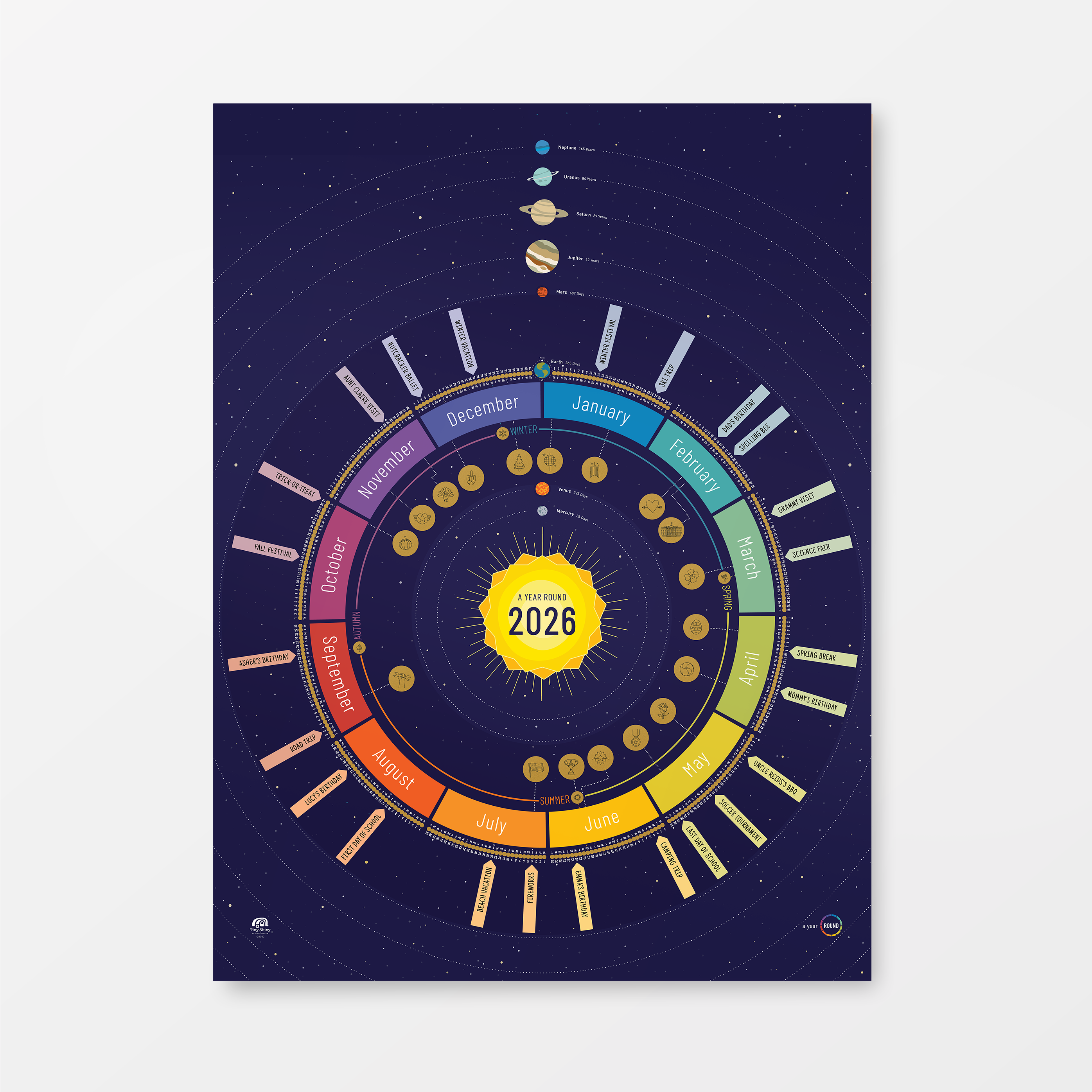



A Year Round Scratch-Off Calendar for Kids & Classrooms
A Year Round Scratch-Off Calendar for Kids & Classrooms
Transform your child's understanding of time with our Year Round Scratch-Off Calendar — a hands-on, visual way to teach kids about time. Great for families, classrooms, and visual learners alike. Choose the version with 18 popular U.S. holidays pre-printed, or the Blank Edition, a clean slate ready for you to personalize with the dates that matter most to your family.
• Visualize the entire year at a glance.
• Scratch off days and track your progress as you orbit the Sun.
• Includes sticker flags for personalized events.
• Customize further with optional scratch-off sticker sets — birthdays, school events, religious holidays & more (sold separately).
• Supports visual and hands-on learning approaches.
• Provides a concrete, foundational understanding of calendar time.
Couldn't load pickup availability
More Info
More Info
Specs
Specs
Shipping & Returns
Shipping & Returns
Shipping:
Orders typically ship within 24-48 hours.
Pre-order items will ship on the estimated date above. Please note that these estimated dates are subject to change due to production or shipping delays.
Cancellations & Returns.
Items can be canceled at any time before the item is shipped. Our standard return policy applies once delivered.
You have 30 days to return unused items in their original packaging. Return shipping costs are the responsibility of the buyer.
Share this product
Time is an abstract concept that can be tough for kids to grasp.
So we re-imagined the calendar to be...

Educational
Displaying the year as a single Earth orbit provides a concrete way to understand time.

Engaging
Scratch-off elements add an extra layer of fun to holidays and the daily passage of time.

Visual
See the whold year and give kids a big-picture view of time and the flow of the year.
Testimonials

Abigail B
Already a treasure!
Where to begin?! This calendar is such a great tool! From the warm/cold corresponding colors and weather (Northern Hemisphere), to the interactiveness of scratching off days, the quality, the size, the planets, which lend to the understanding of "orbiting"... it's just perfect! It teaches so many things in a hands-on and fun way!

Laura S
Love these calendars!
This calendar has become a staple in my household. My kids love scratching off our special events and holidays, and I love having a visual way of teaching my kids about the days, weeks, and months of the year!

Kerri W
Everyone should have one!
I bought a lovely wooden calendar for my 7 year old but he was still struggling to grasp the concept of of how days and months make up a year. It has been a game CHANGER! Not only is he gaining a better understanding of the cyclical nature of time, it's also helping our whole family keep track of important events.

Melissa M
So Cool!
Really helped my 5 year old grasp time and holidays move in a circle with the rotating solar system

John G
Impeccable idea, design, execution
I came across this via an idea I was trying to teach my children, and had searched the internet with "surely someone did some simple version of this idea." Turns out someone had done not just a simple job on this idea, but a marvelous fantastic impeccable job on this idea. The calendar is just what it needs to be. Everything is so well thought out that I hope to buy several more to use every year.

Eira S
Highly recommended!
We Love it!!!
Frequently Asked Questions
What's a good age to start using the calendar?
What's a good age to start using the calendar?
We designed A Year Round Calendar to grow with your child, starting as young as 3. At that age, kids won't yet be tracking dates precisely, but even just seeing the calendar can spark real understanding. We noticed this firsthand with our own 3-year-old, who asked about a holiday that was still months away. Instead of trying to explain it in words, we simply pointed to where we were on the calendar and where that holiday fell, most of the way around the circle. That was enough for them to get it: "Oh, that's a long ways away." No explanation of weeks or months required, just seeing the distance.
By ages 5 to 8, most kids can use it more directly, tracking their own progress toward a specific day, adding sticker flags for upcoming events, and noticing how the seasons and holidays repeat in a predictable pattern each year. And it doesn't stop there: plenty of our customers keep using it well past that range, since planning ahead, setting goals, and seeing the whole year at a glance is useful at any age, kids or adults.
Why does the calendar go clockwise and start the year at the top?
Why does the calendar go clockwise and start the year at the top?
We designed our calendar to move clockwise to mirror the familiar motion of clock time—a direction children will come to recognize and intuitively understand. While it’s true that the Earth orbits the sun in a counterclockwise direction when viewed from above the North Pole, that same orbit appears clockwise if viewed from the South Pole. So, there’s no single “correct” direction—just different perspectives.
We also chose to place January at the top to represent the idea of the “top of the year,” much like how we think of new beginnings or a fresh start.
Over time, we’ve learned that people visualize the year in many different ways, and we love that diversity of thought! Our design choices reflect a blend of science, familiarity, and visual clarity—helping kids make meaningful connections between the passage of time, the seasons, and the circular motion they already associate with clocks.
Why does the Popular US Holidays version include those specific holidays?
Why does the Popular US Holidays version include those specific holidays?
We chose to feature holidays that are most widely celebrated in the U.S., thinking of “the masses,” while also keeping the design clean and manageable for kids—too many holidays can create visual clutter or feel overwhelming. It was a difficult selection process, and we in no way want anyone to feel excluded or marginalized.
That’s why we also created the blank edition—perfect for families who want to celebrate only the holidays that are meaningful to them. We’re continuously working on new scratch-off sticker sets to help you create the calendar that best fits your family. If you’d like to see other sticker options or have ideas for future sets, we’d love to hear from you—just send us a message!
Why is understanding time so hard for young kids?
Why is understanding time so hard for young kids?
Time is abstract — you can't hold it, point to it, or watch it the way you can with a shape or a color. For young children who are still building an understanding of the world through what they can see and touch, concepts like "next week" or "in three months" simply don't have anywhere to attach. Research on child development consistently shows that a true grasp of calendar time (days building into weeks, weeks into months, months into a year) doesn't fully click until somewhere between ages 5 and 8 — it's not a matter of a child being behind, it's just how this particular kind of thinking develops.
That's exactly why we designed A Year Round Calendar the way we did. By turning the year into something a child can see, touch, and physically mark as it passes — scratching off each day, watching the seasons curve around a single circle — we give kids a concrete anchor for an idea that's normally invisible. It doesn't rush the timeline nature sets for a child's development, but it does give them something real to hold onto while they get there.
How do I explain "How many days until ___?" to my child?
How do I explain "How many days until ___?" to my child?
It's one of the most common questions a young child asks, and one of the hardest to answer in a way that actually means something to them. Saying "12 more days" doesn't land the same way for a child who doesn't yet have a working sense of what a day even is. What helps is making the counting itself visible and hands-on, rather than just verbal.
This is where A Year Round Calendar does a lot of quiet work. Because your child can physically scratch off each day as it passes, "How many days until my birthday?" turns into something they can answer themselves — by counting the unscratched dots between today and the date they're excited about. It shifts the question from something only a grown-up can answer to something a child can explore and solve on their own, which tends to make the wait feel a little more within their control.
How does Montessori-style teaching approach time and calendars?
How does Montessori-style teaching approach time and calendars?
Montessori education leans heavily on concrete, hands-on materials before introducing abstract ones — the idea being that children build true understanding by physically manipulating something real, not just hearing it explained. Time is treated the same way: rather than jumping straight to a written calendar full of numbers and abstract labels, Montessori classrooms often use physical, visual tools that let a child see the whole shape of a day, a week, or a year at once, and interact with it directly.
A Year Round Calendar was designed in that same spirit. Its circular layout mirrors the way Montessori materials often represent time as a cycle rather than a straight line — echoing the Earth's actual orbit — and the scratch-off, sticker-flag format gives kids a physical, repeatable way to interact with the passage of time rather than just observing it. You don't need a Montessori classroom to use it this way — the same hands-on approach works just as well at home or in any traditional classroom setting.